Buried Treasure: The Economic Paradox Keeping Valuable Metals Trapped in America's Electronic Waste
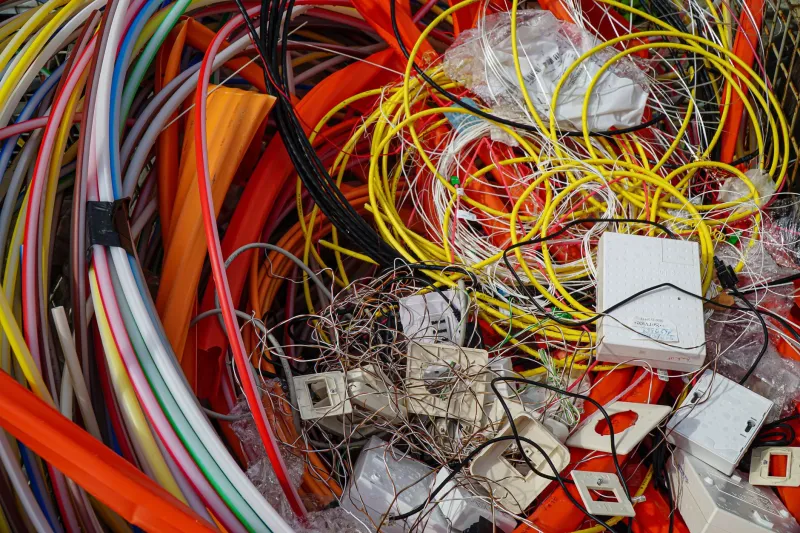
Every year, Americans discard roughly 6.9 million tons of electronic devices — smartphones, laptops, tablets, televisions, and the ever-multiplying array of smart gadgets that define modern domestic life. Stacked end to end, that volume of discarded electronics would encircle the Earth several times over. Inside each of those devices, however, sits something that rarely makes headlines: a concentrated deposit of precious metals that, in aggregate, represents billions of dollars in recoverable material.
So why is the vast majority of it never recovered?
The answer lies not in a lack of technology, but in a tangle of economic incentives, deliberate design choices, and regulatory gaps that make proper e-waste recycling one of the most persistently dysfunctional corners of America's waste management landscape.
The Hidden Value Inside Your Drawer
A single metric ton of smartphones contains roughly 300 grams of gold — approximately 100 times the concentration found in a metric ton of gold ore. Beyond gold, modern consumer electronics are dense with silver, copper, palladium, cobalt, lithium, and a suite of rare earth elements critical to the devices themselves. The United Nations Environment Programme estimates that the global value of recoverable materials in e-waste exceeds $57 billion annually.
Yet only about 17 percent of global e-waste is formally documented as properly collected and recycled. In the United States, federal estimates suggest the figure is similarly grim, with many devices either languishing in household storage, routed to informal recyclers operating outside regulated frameworks, or — most troublingly — exported to overseas processing facilities where environmental and labor standards are far less stringent.
The arithmetic seems absurd on its face. If the material inside discarded electronics is genuinely worth billions, why isn't the market correcting itself?
Designed Against Disassembly
Part of the answer begins at the engineering stage, long before any device reaches the end of its useful life.
Over the past two decades, consumer electronics manufacturers have systematically moved toward designs that prioritize thinness, aesthetic integration, and proprietary components over repairability or end-of-life recyclability. Batteries are glued rather than screwed. Screens are fused to frames. Circuit boards are miniaturized and densely layered in ways that make material separation technically demanding and economically expensive.
Right-to-repair advocates have documented this trend extensively, arguing that it serves manufacturers' commercial interests — driving replacement purchases rather than repairs — while externalizing the environmental and economic costs onto consumers, municipalities, and the broader recycling ecosystem.
For recyclers, the practical consequence is stark: dismantling a modern smartphone to the point where precious metal recovery becomes viable requires specialized equipment, trained labor, and chemical processing that most facilities simply cannot afford at the volumes and price points the current market supports.
The Export Loophole
When American consumers drop their old electronics at a collection event or retailer take-back program, they often assume the material is heading to a domestic facility where it will be responsibly processed. That assumption is frequently incorrect.
Despite the Basel Convention — the international treaty governing hazardous waste exports — the United States remains one of the few developed nations that has not ratified the agreement's restrictions on shipping e-waste to developing countries. This regulatory gap has allowed a significant portion of American e-waste to flow, legally, to processing operations in West Africa, South and Southeast Asia, and parts of Latin America.
Investigative reporting by organizations including the Basel Action Network has documented conditions at informal e-waste sites where workers — sometimes including children — burn cables to extract copper, use acid baths without protective equipment, and deposit toxic residue directly into soil and waterways. The communities surrounding these sites bear the health consequences of a problem created largely by consumption patterns thousands of miles away.
For recyclers operating in that export pipeline, the economics are straightforward: shipping a container of mixed electronics to an overseas informal processor costs far less than the certified domestic processing that genuine material recovery requires. Without consistent consumer verification or regulatory enforcement, the incentive structure rewards the cheaper, less responsible option.
Where Legitimate Recovery Is Working
The picture is not uniformly bleak. A growing cohort of domestic e-waste processors is demonstrating that responsible recycling can be financially viable — provided the right infrastructure, certification standards, and market relationships are in place.
Certified recyclers operating under frameworks such as R2 (Responsible Recycling) and e-Stewards have built auditable chains of custody that verify material handling from collection through final processing. Several companies have invested in advanced hydrometallurgical and pyrometallurgical systems capable of extracting precious metals at recovery rates that compete meaningfully with virgin mining — and at a fraction of the environmental footprint.
Apple, to cite one high-profile example, has developed proprietary disassembly robots — named Daisy and Dave — capable of processing iPhones at scale to recover components that standard shredding would destroy or contaminate. The company reported recovering more than 2,000 pounds of gold from devices processed in 2022 alone. While critics note that Apple's broader design philosophy continues to complicate third-party repair and recycling, the initiative illustrates what becomes possible when a manufacturer internalizes end-of-life recovery as a business objective rather than an afterthought.
Startups are also entering the space with novel approaches. Urban mining ventures are developing modular processing lines specifically calibrated for high-value material streams. Battery recyclers are scaling operations to meet surging demand driven by the electric vehicle transition. The economics, while still challenging, are shifting as commodity prices for critical minerals rise and supply chain pressure mounts.
What Consumers Can Actually Do
For individuals navigating this landscape, the most important step is verification — not assumption.
Dropping an old device in a retail collection bin does not guarantee responsible processing. Consumers who want confidence in how their electronics are handled should seek out recyclers certified under R2 or e-Stewards standards, both of which maintain searchable online directories. Many municipalities also operate certified household hazardous waste programs that include electronics, often at no cost to residents.
Data security is a legitimate concern that sometimes deters people from recycling electronics at all. Certified processors are required to document data destruction, and most offer certificates of destruction upon request. Performing a factory reset before surrendering a device provides an additional layer of protection, though it should not be treated as a substitute for professional data sanitization on devices that contained sensitive information.
For devices still holding functional value, donation to certified refurbishers extends product life and displaces demand for new manufacturing — arguably the most environmentally significant intervention available at the consumer level. Organizations such as World Computer Exchange and local nonprofits frequently accept functioning devices for redistribution to underserved communities.
A System That Needs Structural Reform
Ultimately, consumer action alone cannot resolve a problem rooted in structural economics and regulatory gaps. The United States lacks a comprehensive federal e-waste law, leaving a patchwork of state-level programs — some robust, some nominal — that creates inconsistent outcomes depending on geography.
Extended producer responsibility legislation, which shifts the financial burden of end-of-life collection and processing onto manufacturers rather than municipalities or consumers, has gained traction in several states and represents a policy framework with demonstrated success in Europe and parts of Asia. Advocates argue it would fundamentally realign the incentives that currently reward disposability over durability.
Until those structural conditions change, the buried treasure inside America's discarded electronics will continue to be worth more, in practice, to the informal operators and overseas processors who profit from inadequate oversight than to the certified recyclers working to recover it responsibly.
That is a paradox the country can no longer afford to ignore.